

“Love you guys!” These three words came out of my mouth spontaneously, when I only meant to think them, not say them out loud. I wasn’t saying goodbye to a family member or close friend. Instead I was simply walking out of a public library on a cold winter’s day last month.
The statement was directed towards a young library clerk behind the checkout desk who had just handed me two movies and a big thick novel to get me through the blustery storm headed our way. This particular librarian had never seen me before, even though I’m a frequent visitor to quite a few area libraries. She appeared mildly startled by my outburst of affection, so I tried to clarify it by adding, “I love all libraries.” Decades ago, my library love affair began with the classic Nancy Drew mystery series. As an elementary-aged school girl, I devoured these intriguing novels checking them out one-by-one. Like the Hardy Boys, these classics continue to pique the interest of some aspiring pint-sized detectives.
The books taught me the benefits reading could provide. For instance, one can escape daily problems or exchange a boring existence for an exciting adventure within the pages of a good book. Travel, romance, inspiration, education, spiritual growth, and professional success can all be achieved by reading, too.
Like today, in my youth there were wonderful programs for children. I was hooked after entering my first book contest at the library. Later, as a painfully shy-11-year-old, I had the great fortune of portraying a character from the classic book, Little Women, at my local library. These programs have enabled countless youngsters to acquire: a love of learning, increased imagination, socialization skills, and the list goes on.
Once, the public library was the resource for books of all genres and valuable information of all kinds. This was before Amazon cornered the market on book selling and Google answered lots of our endless questions with rapid search engine capabilities. But don’t for one moment think the library is in danger of extinction. Its place of prominence in a community’s list of amenities remains a high priority. After all, the ground is level at the library.
Whether it’s a book club meeting, group coloring for relaxation, information needs/resources, or children enjoying a movie, the free and often educational events bring folks of all ages and socioeconomic backgrounds together. There are books, magazines, newspapers, videos, and music, in many forms and genres to check out, computers to use, and an endless variety of programs.
The operative word is FREE, and despite being a word most of us like, having access to resources without charge is a necessity for many community members. Whether it’s a single mom or dad, a young family struggling to get established, a senior citizen on a fixed income, or anyone else with a tight budget, the library offers entertainment, education, and social interaction without cost to everyone.

“The Forgiving Jar” on display at a bookstore
Of course, most library lovers are bookstore lovers. Still, many folks couldn’t afford to buy or read a book by a favorite author, unless it was available at the library. Then there are the children. The children who are our responsibility as a community of concerned citizens. Sometimes, when browsing the shelves at the library, I see a young mother wrangling a couple kids, while clutching books and movies that will be making their way into their home.
Witnessing the sheer delight and anticipation in the children’s faces, I remember back to my own days of being a single mom with a little one in tow. I can recall the feeling of fulfillment I had when checking out books and videos for my then young son. The library allowed me to be a better parent by providing these precious commodities when there wouldn’t have been any funds to cover their cost.
February was Library Lovers’ Month, and you might be thinking that the month is already over. But this year, why not do something special for those wonderful library ladies and men who make our lives so much richer? Maybe though, instead of saying, “Love you guys,” like I did, why not say, “Thanks for all you do to make our community a better place all year long!”
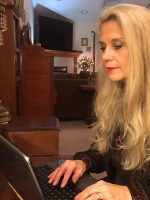
Christina Ryan Claypool is an award-winning freelance journalist and Inspirational speaker who has been featured on Joyce Meyer Ministries Enjoying Everyday Life TV show and on CBN’s 700 Club. Her recent release, “Secrets of the Pastor’s Wife: A Novel,” is now available on all major online outlets. Contact her through her website at www.christinaryanclaypool.com.
.

 What I didn’t know then was that a Civil Rights movement was being birthed out of the frustration regarding injustices that African Americans like Clemmie could no longer bear. Not yet a first grader, I couldn’t imagine anyone hating such a wonderful woman, simply for the color of her skin. Eventually, my mother regained her health, so Clemmie no longer came to care for us. Yet her colorblind love, which was based on her faith in the Gospel’s message, “…Love one another, as I have loved you…” had made a lasting impression.
 he late Jewish Holocaust survivor, Liesl Sondheimer, often shared a profound truth regarding racial forgiveness. Like Nazi Hunter Simon Wiesenthal, Mrs. Sondheimer spent decades retelling the painful account of the extermination of more than six million European Jews during World War II. Unlike Wiesenthal’s quandary concerning forgiveness outlined so poignantly in his book The Sunflower, my dear friend, Liesl, always maintained that, “You must forgive, but never forget, or Hitler has won.”
 “Public speaking ranks as our No. 1 fear, even outranking the fear of death, says Peter Desberg, PhD, professor of psychology at California State University,” according to
 Secondly, “Be prepared.” Absolutely, do a run-through for technical issues at the designated venue ensuring your technology is compatible with their technology. Plus, practice, practice, practice your presentation in front of a mirror, for a willing family member, or even for your dog. Also, make sure it fits into the allotted time slot. Thirdly, “Be confident.” Your knees might be shaking, your stomach might be rumbling, and you might be perspiring from terror, but employ the classic philosophy, “Don’t let them see you sweat.” Smile and act like “I’ve got this,” even if you feel like you don’t.
 “Engaging your audience” holds true whether you are speaking to a civic club, delivering a sermon, reporting for TV, or instructing a college class. Envision one person in the crowd, who sincerely needs to hear what you have to say. Then speak to that fictitious individual who probably really does exist out there. That way your presentation won’t seemed staged or emotionless.
 Christina Ryan Claypool is a freelance journalist and public speaker both in the secular and Christian communities. Her new Inspirational book,
  During October, we observe “Adopt a Shelter Dog Month” sponsored by the


 “I don’t have a pencil.” The over-sized middle school boy explained his plight to me, while staring into space and not doing his assigned work. “My mom’s dead,” he said matter-of-factly, offering this as the reason why he was without a pencil. I swallowed the lump in my throat, refusing to let the adolescent see my look of unchecked sympathy, because no teenager wants to be the object of anyone’s pity. I grabbed a pencil off of the teacher’s desk and handed it to him with an encouraging smile.
 So, recently when I read the Internet headline,
 Dear young woman,
 Education will be a game changer for you. Read, read, read, anything enabling you to grow, to learn, to embrace new horizons. Be disciplined in your studies, delay immediate gratification to achieve your educational goal whatever that is. The life you change will be your own.
 About your family: They need to be your top priority. Success in a worldly sense will fade away soon enough, but you will find out your family is all you really have.
 “No, I don’t walk that way – you have to turn right on the next street – because Steve might be out and I’ll get a chance to see him,” I explained this directional route to my husband on a recent walk through the neighborhood. “Whenever I see Steve, he’s so adorable, I just want to hug his neck.”
 But two years ago in December, I saw Kaitlin’s winning smile again. Tragically, this time it was in an obituary photo. I learned her last name, and that this vibrant young lady with so much potential, didn’t have all the time in the world. At only 24, she had lost a battle to cancer. I was deeply saddened by the monumental loss of such a gentle soul for all her loved ones. For me, there had been no chance to say, “Good-bye,” or to express my appreciation.
 When I look out of my kitchen window I can see the back of Miho’s house. For a long time after she was gone, when evening’s darkness would settle over the neighborhood and the timed lights would turn on in the empty home, I would imagine she was still inside clearing the supper dishes. I did the same thing for weeks when the school bus would come in the morning to pick up the children who live nearby. As was my daily habit, I would gaze out the same window absentmindedly searching for Tetsu and Haru’s faces among the little ones. Then with sadness, I would remember that they had returned to their native country.
 greatly contrasted the lifestyle they had experienced in Ohio. I would learn much from Miho during the time we were able to spend together, despite our busy schedules. Language was a barrier in the beginning, but that barrier was bridged by the kindred spirit that we shared. Miho was not my first Japanese friend though. It was Kyoko, whom I originally met in an exercise class at the YMCA, who paved the way for me to understand how courageous the Japanese families who live among us, up and down I-75 are. The women are especially brave, because while their men find identity and professional camaraderie in their workplace, the ladies must find their own purpose in a country that is so foreign to their own.
 Yet, Kyoko and Miho shared a common trait that enabled them to find friends, and rewarding outlets and activities, while in the United States. They both sought diligently to master the English language, even though this can be a daunting challenge. By personality, they were also extremely friendly, willing to try new challenges and social situations, and accepting of others. I miss both of these dear ladies, but they left me with an important lesson about being aware of the transplanted individuals in our communities, not only the Japanese, but others who might be struggling with feelings of isolation.