A Recovery Story: With a Little Help from my Friend

This is the first time in more than four decades, I won’t be able to wish my dear friend and lifelong mentor, Happy Birthday. Sadly, Michael “Mike” Lackey, 77, died on July 3, 2025. If you read his online obituary, Michael Lackey Obituary (2025) – Lima, OH – The Lima News it details his noteworthy career as an award-winning journalist. Still, it doesn’t mention the fact, he forever changed a life. Mine.

Truthfully, I wanted to write, “A Tribute to Mike Lackey” column years ago. When I asked his permission, he erupted into laughter, finding the idea hilariously funny. Ever the newspaperman, he turned serious and said something like, “They won’t publish that kind of column, until I’m dead.” As usual, he was right.

Mike Lackey spent almost four decades keeping his west central Ohio community informed. He first joined the staff of The Lima News in 1972 as a sportswriter. Originally, a Dayton native, he graduated from Kettering Fairmont West High School and then Earlham College.  

By the time I met him in the late 1970s, he was the assistant city editor at Lima News. I was in my early twenties working dead end jobs trying to pay my apartment’s rent. Depressed and broke, I had been forced to quit The University of Akron in my junior year and come home to Lima.

As a teenager, my battle with depression began. While a 16-year-old junior at Lima Central Catholic High School, a near fatal suicide attempt landed me in the local psychiatric ward followed by commitment to Toledo State Mental Hospital. Eventually, self-medicating ongoing emotional struggles led to addiction.

Mental Health was in the infancy stages and individuals like myself, were frequently either ostracized or demonized. Despite this, I desperately wanted to become a journalist. Although the stigma surrounding mental health issues was rapidly closing the door to my professional opportunities. Almost miraculously, when I could no longer bear my hopeless circumstances, I met Mike Lackey.

About the same time, I was fortunate to enroll in Bluffton College with a goal of completing my degree. Under the direction of the late Dr. Lawrence Templin at Bluffton, Mike Lackey, by then city editor, took me on as an intern for the 1981/1982 academic year. He was aware of my past but gave me the opportunity anyway. As with all cub reporters, the veteran editor painstakingly and with impeccable integrity taught me the “nuts and bolts” of reporting. 

Mike’s disability was more obvious than mine. He was born with cerebral palsy. He struggled to walk unassisted, fighting confinement in a wheelchair. I learned to fight for a better future by watching him valiantly defy his own physical limitations. Through his steadfast example, he taught me to never use a personal disability as an excuse. Rather the talented wordsmith relied on his brilliant mind to forge his path in journalism.

While he was an incredible editor, he was also a gifted writer. He returned to his craft full-time becoming well known as the Lima News columnist for decades. Inevitably, a wheelchair did become part of Mike’s reality, so did numerous statewide Associated Press Awards, along with the respect of countless community leaders.

Mike Lackey believed in me, when no one else did, not even myself. I often wonder how many other aspiring journalists this natural mentor inspired. In 2008, the award-winning writer was forced to retire prematurely after a daunting battle with Guillain-Barre syndrome. The disease caused him to have an extended stay in a nursing facility.

But in traditional Lackey style, he fought his way back, later writing the 2013  award-winning book, “Spitballing: The Baseball Days of Long Bob Ewing” about a former Cincinnati Reds player. Mike’s true love was Reds baseball. Winning or losing, he was a faithful fan. 

 As for faithful, following my internship, Mike Lackey remained a mentor and friend for the rest of his life. For decades, he would edit books or articles I wrote, refusing payment other than a Kewpee double cheeseburger. He beamed with pride, when I finally won my own 2014 Ohio Associated Press award.   

The veteran newspaperman took a chance on me as a young woman struggling to overcome the societal stigma regarding mental health/addiction. This helped me fulfill my dream of becoming a journalist and provided the incentive for learning to live in recovery one day at a time. If you want to honor his legacy, you could give someone like me an opportunity.

In the end, my heart is filled with gratitude to God and also profound grief. I’m beyond grateful God gave me the gift of Michael Lackey as a lifelong mentor and friend. The grief is knowing, I will always miss him more than words can express.

Of course, the missing is worse on special days, like his birthday. So, “Happy Birthday, Michael! I couldn’t let the day go by without letting the world know how you forever changed a life. Mine.  

Christina Ryan Claypool is a Chicken Soup for the Soup and Guideposts book contributor and author of the inspirational, “Secrets of the Pastor’s Wife: A Novel.” Contact her through her website at www.christinaryanclaypool.com.


Pray for 3 Doors Down lead singer Brad Arnold

Through current news reports the world has learned that rock group 3 Doors Down lead singer, Brad Arnold, has been diagnosed with stage four kidney cancer.  Arnold has been vocal about his Christian faith in recent days and for years about his sobriety from alcohol addiction. The singer is now taking time off the road to address his cancer crisis.

If you’re an individual who believes in praying to the God who is the Creator of this vast universe, it would be a good time to add the famous singer to your prayer list. If you want to join in praying, how about using the hashtag #prayforBradArnold to encourage him that there are folks who care.

I’ve been concerned about Arnold, because one of his band’s famous songs, “It’s Not My Time” supported me emotionally when I was recovering from a serious auto accident two decades ago. Back then, “It wasn’t your time,” was what Nate, the body shop technician said matter-of-factly surveying my husband’s wrecked vehicle. Then he began wrapping the totaled auto with clear plastic, while I dutifully gathered my personal possessions.

Just days before, the black sedan’s pristine finish glistened in the sunshine. Now, what was left of it was a reminder of how blessed I had been to survive.

“It wasn’t your time,” was Nate’s simple theology.

His statement reminded me of something German theologian Dietrich Bonhoeffer once wrote in his Letters and Papers from Prison, “We all have our appointed hour of death, and it will always find us wherever we go. And we must be ready for it.”

Bonhoeffer was a Lutheran pastor who refused to sit idly by as Adolph Hitler killed millions of Jewish citizens during World War II. Instead the German leader joined a movement to have Hitler assassinated, resulting in his 1943 imprisonment. Bonhoeffer’s own appointed hour of death occurred in 1945, when at only 39 years of age he was hanged at the Flossenburg concentration camp. 

Anyway, I’m not comparing my car accident to the slain scholar’s situation, because I felt blessed to be alive that afternoon as I said good-bye to the wrecked vehicle. After all, a few days earlier while driving in heavy four-lane traffic I glanced in my rear-view mirror and saw a car rapidly approaching. My frantic mind quickly realized that there was nothing I could do. Suddenly, I heard the sickening sound of crunching metal and felt the forceful impact that propelled me forward quite a distance.

Miraculously, there was no vehicle directly ahead, nor had I been pushed into an adjoining lane. Momentarily dazed, I gratefully assessed that my injuries were non-life-threatening, although they would require a trip to the hospital. The young man whose vehicle’s front end had connected with my demolished back end assured me that he was ok, too. “We can always get a new car, but we can’t replace precious people,” was the philosophy I inherited from my late mother.

Thankfully, I knew my husband agreed with my practical view of totaled automobiles, since I just “happened” to borrow his car that day. Providentially, Larry’s vehicle “was” proven to prevent injuries in crash tests. It lived up to its promise, even though it resembled a folded accordion after the wreck.

photo (2)There were several other remarkable occurrences surrounding the event. When dressing the morning of the accident, my treasured angel pin, a gift from late Jewish Holocaust survivor, Elisabeth Sondheimer, seemed to sparkle warningly as it fell to my bedroom floor. 
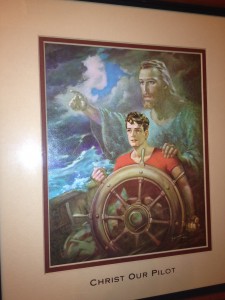
I also placed an antique picture of Jesus standing behind a sailor who is navigating a ship’s wooden wheel behind the driver’s seat that day. The portrait depicts the Jewish carpenter with one hand lovingly resting on the young seamen’s shoulder and the other arm extended, pointing him in the direction he needs to go amidst the turbulent seas.

My plan was to drop the inspirational artwork off at a friend’s office, since he was encountering some rough seas. When cleaning the car out at the body shop, I found the glass and wooden framed picture undamaged just as Nate was sharing his wise advice about it not being my time.Jesus is my Pilot

The borrowed car, the angel pin, and the antique picture are all reminders of my own belief that God is always in control, even when life seems randomly chaotic. However, my greatest blessing was the fact that apparently it wasn’t my “appointed hour of death” as Bonhoeffer once wrote. Because someday, death “will find me,” just as it finds us all, since nobody gets out of here alive. 

And death can be cruelly unfair. I was reminded of this heartbreaking reality a mere ten days ago. My own family lost a beloved member in the prime of her life after she fought a long and courageous battle. Due to privacy, I won’t share any details. But I will say, I’m sure those who love her would have willingly given up some years of their own time if they could have. But it doesn’t work like that, only God has the power to control time.    

For all the folks remaining on this Earth, perhaps some will appreciate the wisdom in the song lyrics of the former 2008 hit, It’s Not My Time by 3 Doors Down.  As the lead singer, Brad Arnold, not only sang this song, but he’s one of the band’s members who wrote it. 

The lyrics say, “My friend, this life we live is not what we have, it’s what we believe. And it’s not my time. I’m not going ….” Hopefully, you and I, along with Brad Arnold, are not going anywhere, anytime soon.  For now, we’ve all been granted the priceless opportunity for one more day with those we love.

Christina Ryan Claypool is an inspirational speaker, frequent Chicken Soup for the Soul book contributor, and author of the inspiring book club read, “Secrets of the Pastor’s Wife: A Novel”. Learn more at her website: www.christinaryanclaypool.com

Golden Wings for a Grieving Traveler

Mother’s Day is upon us. Like me, you might be missing your mom. There are also mothers experiencing the painfully unnatural grief of missing children. After all, we assume that someday we will bury our parents, but never anticipate having to grieve the death of a child.

Mother’s Day spent mourning a lost loved one can be an especially, treacherous emotional sea to navigate. Maybe though, your mother or child didn’t die, instead circumstances have somehow estranged you. Life can be complicated, but personally I believe in happy endings.

That’s why I’m a sap for sentimental movie plots like the traditional boy gets the girl or a stranded puppy finds their way home. The holiday classic, “It’s a Wonderful Life,” always thrills me when a rather bumbling angel named Clarence finally gets his wings.

Although, I must admit I wasn’t thinking about the possibility of a happy ending on that awful afternoon almost 14 years ago. I sat rigidly in my cramped seat on an airplane trying not to cry. As I gazed at the oblivious passengers, the business flyers looked weary, but other folks seemed animated traveling for pleasure and family excursions.

Family. That was my problem. My 78-year-old mother, Glenna Sprang, had died suddenly the day before. An accomplished organist, Mom played two church services on Sunday morning. Later that afternoon, pain from a kidney stone gone terribly wrong caused her to be rushed by ambulance to a Philadelphia hospital. By Wednesday afternoon, I stood helplessly at her bedside watching my mother breathe her last breath, just as she had been with me when I breathed my first.

Glenna Giesken Sprang

Glenna Giesken Sprang

I felt isolated by grief, as I traveled back to Ohio to be with family until her funeral. Being a Christian speaker by profession, my mother had left a written request that I “preach” her funeral, if I was able. I was honored by her last wish, but my heart was broken, and I had no idea how I was going to do it.

That’s when a forty-something flight attendant who I’ll call Dan, pulled his beverage cart next to my aisle seat. The seasoned steward shared the same reddish hair color that my four brothers and sister have. The color that caused them to be teased ruthlessly when we were kids.

At that very moment, an obnoxious traveler was mercilessly making fun of Dan’s hairstyle. I gave the flight attendant a sympathetic look, but the undaunted steward defiantly threw his head back while laughing profusely. For the first time in several days, I laughed, too. Suddenly, Dan looked deeply into my exhausted eyes and sounding concerned asked, “Are you going home?”

“My mom just died,” I blurted out. Instantly, I was embarrassed that I had burdened a stranger with my grief.

“It will get better,” Dan said encouragingly. He then shared the story of losing his own mother some years earlier promising me that time would ease my heartache.

It was a short flight, with the airline attendant being busy for the rest of the trip. Minutes before landing safely on the runway, Dan made his way back to my seat at the rear of the plane. Then he ceremoniously handed me a pin shaped like a pair of golden wings. “Now, you can say, you got your wings at the same time as your mother got hers,” he said with a boyish grin.

When I arrived home, I placed my “wings” on the vanity’s top in my bedroom. The following week, I fulfilled my mother’s last wish of preaching her funeral describing her courageous life with the Scripture, “I have fought the good fight, I have finished the race, I have kept the faith.” [2 Timothy 4:7]

Then I allowed myself to grieve. During those difficult months, every time I looked at the golden wings, I clung to Dan’s promise that time would lessen the pain and that someday my broken heart would begin to heal.

There’s another promise that also gives me great hope as a Christian believer, the promise of a Heavenly reunion. Of course, I still miss Mom, but I’m no longer overwhelmed by earthly sadness, instead I’m excited about seeing her again someday in Heaven where she is now experiencing incomprehensible joy. Mom and me

If you are the one grieving inconsolably, hang on, time can be a great gift in healing grief. For me, although the missing never stops the unbearable heartache has lessened, just as the flight attendant told me it would. In reality, I know that Dan was probably just a compassionate cabin steward, but to a brokenhearted traveler, he seemed like an angel in disguise.

Christina Ryan Claypool is an Amy Award winning freelance journalist and Inspirational speaker. Her book, “Secrets of the Pastor’s Wife: A Novel” is available on all major online outlets.

Breakfast with a not-so-famous Tony Bennett

It’s easier than it’s ever been to become famous. In my formative years before the advent of the Internet
overnight success was non-existent. Still, back then a lot of little boys grew up wanting to become a well-known president, and girls dreamed of being a famous movie star or the wife of someone important. When feminism hit in the seventies, a lot of young women also decided they wanted to be president. I’ll bet not too many young people today would desire the notoriety of the oval office, but that’s a whole other blog post.

Celebrity has never been a huge draw for me. Of course, it would be great to win a Pulitzer Prize like poet Sylvia Plath, or a Nobel Peace Prize like civil rights leader Dr. Martin Luther King Jr. Yet like many renowned people, fame exacted a tremendous cost. The brilliant Plath took her own life, and the inspirational Dr. King was senselessly slain for his convictions.

Anyway, dependent on the size of your pond, there will always be a more famous fish. More importantly, if you climb to the top of the ladder, there’s a good chance you will have to experience the long climb down more than once.

For example, famed singer Tony Bennett was definitely not at the top of his game, when I served him breakfast in the late 1970s. I first saw the musical legend early in the morning, as he sat waiting for a server at the former Cascade Holiday Inn in Akron, Ohio. He was alone, reading his newspaper for what seemed like an eternity, while the small group of waitresses where I worked, argued about who should wait on him.

My co-workers seemed awed by his celebrity, so nobody wanted to take his table. I assumed the poor man was hungry, and even though he wasn’t in my section, I volunteered. Mr. Bennett needed breakfast, and I was a struggling college student with more than a few real problems in need of a good tip.

Honestly, I had almost no idea who he was. By then, his career was in a downward spiral. Two of his mid-70s albums had failed to gain popular success, and he had parted ways with his record label. I had heard of his 1962 hit, “I left my heart in San Francisco,” but was too young to be impressed.

Sadly, I took the singer’s order for Eggs Benedict and served him without even acknowledging that I knew who he was. The talented performer was very polite, and I should have at least complimented him on his incredible voice. Thankfully, Bennett didn’t need my affirmation, because the test of time has proven his enduring talent. By 1986, with a new album and his son as manager, the Italian crooner was back on the map, and more Grammys would eventually follow.

There were also celebrity duets for the famous tenor, probably the most notable was when he teamed up with Lady Gaga. His 2014 CD with her titled, “Cheek to Cheek” won a Grammy for Best Traditional Pop Vocal Album. A couple years later, came his dreadful diagnosis of Alzheimer’s disease. Still, Lady G is reported to have remained friends with her unlikely duet partner to the very end.

Bennett was an artist extraordinaire in more ways than one, because he was also known for his paintings.  With his wife, Susan Benedetto, the singer founded the Frank Sinatra School of the Arts where Susan once served as both a teacher and an assistant principal. The world lost this 96-year-old gentle giant of a man on July 21st, which is why I wanted to pay tribute to him one last time with this post.

After all, it’s been over four decades since that fated breakfast, and meeting the amazing performer was a once in a lifetime opportunity. I’ve always regretted my omission of not expressing my gratitude to him for the importance of his musical contribution. Especially, when he was at the bottom of his game. The truth is, I was a troubled kid back then at the bottom of my game, too.

So, Tony Bennett, I would like to publicly apologize to you for not realizing that you and I were both only in a temporary slump. Your music would end up bringing more joy to our world than you could have imagined.  I read online that your last words were the very ones I wish I would have had a chance to say, “Thank you.” It’s reported you said them to your son, Danny, but I want to take this final opportunity to say them to you, “Thank you, Tony Bennett. Rest in peace. You made the world a more beautiful place by being here!”

http://www.christinaryanclaypool.comChristina Ryan Claypool is an Amy and Ohio AP award-winning freelance journalist and speaker. She has been featured on CBN’s 700 Club and Joyce Meyer Ministries Enjoying Everyday Life TV show. Her inspirational novel, “Secrets of the Pastor’s Wife” is available on Amazon and all major online outlets. Contact her through her website at www.christinaryanclaypool.com.

Mom’s Advice about Getting Older

My Beautiful Mother

The anniversary of losing someone you love can be quite painful. The calendar date, month, or season can bring back the feeling of the initial grief, as if you are reliving the loss all over again.

Some folks believe this anniversary business is best dealt with by shutting themselves away for the day. Other individuals make a plan to do something special to honor and celebrate their late loved one’s life.

This October, I can’t help but contemplate the sights, sounds, and even fragrance of fall when death came unexpectedly more than once leaving such a gaping hole in my heart. For instance, 11 years ago, my seemingly healthy 78-year-old mother died suddenly of a kidney stone gone terribly wrong.

The fall afternoon my mom breathed her last breath the sky was vivid blue, the leaves were breathtaking shades of red, yellow, and green, and the crisp autumn air smelled invigorating clean. This scene is forever etched in mind, because it was such a sharp contrast to the gut-wrenching task of saying goodbye.

Still, with time grief lessens. The shock, heartbreak, or even horror of death and mourning are often replaced with pleasant or poignant memories from happier days. Like the seemingly meaningless event which occurred on one of my last visits to see my late mother who lived out of state.

Mom and me on our last Christmas together 2009

When family was visiting, Mom would usually awaken early and brew a pot of coffee and set something out for breakfast. We were in the kitchen alone on one of these occasions, when I noticed her bathrobe was threadbare and shiny. In her mid 70s by then, she and my stepfather lived in a newer Philadelphia suburb.

At this point in her life, she had the financial means to buy a new bathrobe. As a young mother of seven biological children, her situation had not always been so prosperous. In the early days of mothering, she often sacrificed personal items for herself to purchase groceries or something for one of her children.

That’s why sometimes my mother could be more than thrifty when it came to spending money on herself. This is probably a quality most nurturing moms can relate to. Yet her once pink housecoat had faded to a pinkish ivory and was glaringly worn. Realizing she was entertaining my husband and myself that weekend, I knew it must be her best robe or she wouldn’t be wearing it in front of us.

When mom and I were alone, my concern overwhelmed me. Without meaning to be unkind, I blurted out, “Mom, you desperately need a new bathrobe. Yours is so shabby I can see through the fabric. It looks awful.”

“Oh, thank you for telling me,” Mom said sincerely, appearing blissfully oblivious to the shape of the garment. Thankfully, she wasn’t insulted by my remark, sensing my heart in wanting her to have better.

“Didn’t you realize it was worn out?” I asked with concern, surprised she seemed unaware of its condition, especially since Mom was the family fashionista. The truth is, I was frightened my mother might be experiencing some cognitive impairment as a result of aging. The dreadful word, “dementia” menacingly flashed through my mind.

“No, I didn’t notice how worn out it was, and I really appreciate you telling me,” Mom said candidly. “You see, honey, sometimes as people get older, they don’t notice the condition of the things they see on a daily basis.”

Mom’s advice has served me well this past decade

Gradually with aging myself, I have come to more fully understand what Mom was saying. Complacency or a desire for comfort can make it difficult to be objective when something has passed its stage of usefulness and needs to be replaced with something new. It might not be merely an old bathrobe, but a more important item like an unsatisfying career, a toxic relationship, or an unhealthy lifestyle requiring a dose of reinvention.

My mother’s practical advice has served me well this past decade even though I continue to miss her greatly. So, I decided to honor her memory by passing it along. Besides, I don’t grieve without hope, because Mom and I had a shared faith and trust that Heaven really is real. I like to think of her waiting there, brewing coffee and opening the box of donuts. Oh, what a joyous reunion that will be.

Christina Ryan Claypool is an award winning freelance journalist, Chicken Soup for the Soul contributor, and author who has been featured on Joyce Meyer Ministries Enjoying Everyday Life TV Show and CBN’s 700 Club. Her inspirational, “Secrets of the Pastor’s Wife: A Novel” is available on all major online retail outlets. Here’s the Amazon link to learn more.

A Tale of Two Cardinals

Two CardinalsI never thought much about birds, certainly not Cardinals. Undoubtedly, the males with their brilliant red feathers are eye-catching. Yet not that long ago, I believed that collecting bird memorabilia was better left to those with little to do. Now a few Cardinal keepsakes have found their way into my home.

Most people who grow up in Ohio probably know that the Northern Cardinal is our state bird. It is also the state bird for Illinois, Indiana, Kentucky, North Carolina, Virginia, and West Virginia.

For most of my life, I was just too busy to even notice the crimson creatures who commonly nest in a pair. A pair, that’s what my late mother and stepfather of more than 35 years were. When they died less than five months apart a decade ago, I didn’t think that the holidays would ever be joyful again.

After all, every Christmas my husband and I would fill our car with food, gifts, and suitcases, and make the trip from Ohio to Philadelphia to spend the holidays with them.  Both my mom and stepfather were musicians. She was a church organist and choir director. Neal also became a choir director later in life, although when he was young he traveled the world with the Navy band. They were an ecumenical couple, since my stepdad was a Baptist, but Mom played and directed music wherever the “Spirit” led.

My beautiful mother

My beautiful mother

Christmas at their house was all about music, too. When my husband and I would arrive, often Mom would invite us to join whatever choir she was currently directing on an interim basis. My hubby and I would both try to graciously decline, but somehow Christmas morning would find us reluctantly dressed in choir robes with my mother directing away.

On our last Christmas together in 2009, my then 77-year-old mother insisted I escort my stepfather to the church platform. By then, he was almost 80, and legally blind from diabetes. Still she wanted him to stand behind her as she accompanied the choir and congregation on the pipe organ as they sang Handel’s Hallelujah chorus. I can still hear his deep baritone voice, as he sang out the notes he must have known by heart.

It was such a shock when “Teddy Bear” as he affectionately called Mom died suddenly ten months later in October 2010.  Following her death, my stepfather’s broken heart stopped beating in less than five months, too.

After someone you love dies you often find out things about them that you never knew. For instance, after my mother’s death my sister shared how Mom would often look out the window above her kitchen sink to watch the birds that would gather in their foliage filled yard. I also learned that the crimson-colored Cardinals were a favorite.

After their deaths, as the holiday season began approaching, I was dreading another Christmas without them. I had no idea how I was going to be able to celebrate or create new traditions. Then one day, I was looking out my own kitchen window when suddenly I spied a Cardinal near the evergreen tree in my backyard. There was a second less colorful Cardinal who landed on one of the tree’s branches. Instantly, I realized that these birds were a couple.

I didn’t know then that Northern Cardinals nest as a pair, and that the female is tan, and often has red in her wings or tail feathers. Nor did I know that the male is incredibly protective and that he sings loudly to keep other males away.  So like my stepfather who always kept a watchful eye on my mother. All I could tell was that these two lovebirds were singing a duet. As I watched the Cardinals communicating, suddenly my gloomy mood turned to one of amazement and joy.Neal and Glenna Sprang with Christina Ryan Claypool, daughter

It was then I began seeing Cardinals everywhere, since they remain in the north all year long. For instance, while passing a bookstore, displayed on the store’s glass window, I saw a picture of the red Cardinal with a story about the Christmas legend that surrounds the beautiful bird.

As for the legend, according to www.relijournal.com, “The Cardinal [is] christened the “Christmas Bird” for its spectacular red color….A glimpse of this brilliant bird brings cheer, hope and inspiration on a gray wintry day. This is nature’s reminder for us to focus on our faith; the Cardinal’s scarlet plumage represents the blood of Christ shed for the redemption of mankind.”

For me, two Cardinals singing together were a Heavenly sign reminding me that those we love live on in our hearts. May this season of unexpected miracles bring you the renewed hope found in the One who is the Creator of Cardinals. Merry Christmas and God blessings to you and your family!

Christina Ryan Claypool is an Amy and Ohio APME award- winning freelance journalist and Inspirational speaker. She has been featured on Joyce Meyer Ministries Enjoying Everyday Life TV Show and CBN’s 700 Club, and has an M.A. from Mount Vernon Nazarene University. Her website is www.christinaryanclaypool.com. Her novel, Secrets of the Pastor’s Wife  is available on all major online outlets.  

An Attitude of Gratitude

“In ordinary life, we hardly realize that we receive a great deal more than we give, and that it is only with gratitude that life becomes rich.” Dietrich Bonhoeffer once wrote these words in his famous book, “Letters and Papers from Prison.” It’s inspiring that that the German theologian, who was hanged in a Nazi concentration camp for his resistance to the Hitler regime, was writing about feeling grateful shortly before his untimely death at the tender age of 39.

Let’s be honest, for many of us, circumstances have also been difficult lately, which can make it very challenging to have an attitude of gratitude. Whether it’s the worldwide pandemic, political polarization, financial uncertainty and lack caused by Covid-19, losing a loved one, a chronic physical or mental health issue, or the constant loneliness created by this unprecedented virus, most of us have some good reasons to feel down.

Down was where John Kralik was when he began to write his 2010 memoir, “365 Thank Yous.” The then 53-year-old attorney was financially struggling, going through a second divorce, forty pounds overweight, and rapidly losing hope that he would ever achieve his career goal of being a judge. I first heard about Kralik’s insightful work through a woman I interviewed who had once lost an adult child to cancer. It just felt like something I needed to read. On the back cover it says, “An inspiring, true story about how a simple old-fashioned act – writing thank you notes – led a hopeless, angry, middle-aged man out of despair and into a wonderful life.”

Kralik’s book is more practical than spiritual, yet gratitude has been said to be one of the greatest of virtues. The lawyer certainly convinces his reader that gratitude is indeed a powerful tool, since eventually his life is restored and he even fulfills his dream of becoming a Los Angeles court judge. In 2013, the New York Times best-seller was rereleased under the title, “A Simple Act of Gratitude.” The message of “365 Thank Yous” stays with me, because it is not so much about writing thank you notes, as it is about becoming grateful. Truthfully, I know a lot about thank you notes being raised in a generation where the correct response to a gift was a mandatory card of appreciation. But, I haven’t always known a lot about gratitude.

Rather, I lived much of my life with the cup half-empty mentality, like many Americans concentrating on what I didn’t have.  Not so much desiring material things, rather missing the everyday blessings that are easy to take for granted. Then there are folks who seem to be naturally thankful for everything. “Gratitude is inclusive,” writes the late author Brennan Manning. For example, in his book, “Ruthless Trust” Manning shares about an Alcoholics Anonymous meeting, where a man named Tony once said, “If I had to choose among all the diseases that afflict human beings, I would choose mine [alcoholism], because I can do something about it.”

Being grateful for being an alcoholic is one thing, but what about finding gratitude in the midst of heartbreaking loss? Loss like writer Ann Voskamp experienced when as a little girl, she witnessed her 18-month-old baby sister being run over by a delivery truck. As author of the book, “One Thousand Gifts,” Voskamp admits that she spent many years battling depression and anxiety. The wife of a farmer and mother of six finally finds gratitude by conscientiously observing 1,000 simple gifts in her daily life and poetically writing each one down. “Child sobs ebbing, boys humming hymns, laundry flapping, book pages turning, toothless smiles, forgiveness of a sister, and her list goes on and on.

That an alcoholic man and a grieving woman – both find thankfulness – is sobering. I know it’s a terrible pun, but I think Tony would like it. After all, according to Manning at the A.A. meetings that he attended, Tony “introduced himself as a ‘grateful recovering alcoholic.’”

As Thanksgiving approaches, no matter what is going on in our own lives, there is still much to be thankful for. Gratitude is a daily decision. Not only an attitude, but a way of life. May we find beauty in the ordinary and may our hearts be filled with thankfulness for the little blessings that each new day brings.

For those who have lost so much due to the pandemic and are in a time of agonizing mourning and unbearable grief, let’s pray that we can somehow bring hope to them. All the while, being grateful God can use one broken human being like ourselves to comfort another in a season of brokenness even greater than our own. Happy Thanksgiving and remember, you are loved by God. You are never alone!

Christina Ryan Claypool is an award-winning freelance journalist and inspirational speaker. Her inspirational release, “Secrets of the Pastor’s Wife: A Novel” is available on all major online outlets. Contact her through her Website at www.christinaryanclaypool.com.

.

Remembering a forever young barista

A couple of decades ago, if anyone would have said that people would routinely cough up three or four dollars for a specialty cup of coffee, most folks wouldn’t have believed it. Yet today, it’s commonplace for countless individuals to hand over about that much for their favorite latte, steaming cappuccino, or creamy smoothie.

According to www.foxnews.com, a report from Acorns Money Matters records that “the average American spends approximately $1,100 a year– or $3 each day– on coffee.” But it’s not solely about the beverage, it’s about everything that goes along with it.

Best-selling author, Dr. Leonard Sweet, believes that atmosphere has a lot to do with profitability. In his book, The Gospel According to Starbucks, Sweet writes, “Starbucks built an assumption-shattering business by selling an irresistible experience along with every cup of coffee.” “In 2017, there were 13,930 Starbucks stores in the U.S.,” reports www.statista.com. “The total number of Starbucks stores worldwide has almost doubled in the decade between 2007 and 2017.”

According to www.amazon.com, “Leonard Sweet shows you how the passion that Starbucks® has for creating an irresistible experience can connect you with God’s stirring introduction to the experience of faith in The Gospel According to Starbucks.” As for the coffee shop itself, Sweet attributes the décor, “appealing music,” and a “melody of complex coffee smells” as contributing to the Starbucks “sensory feast.” If we think deeply, that’s part of the pleasure that we find in most coffee shops whether an independent or chain. We aren’t merely buying a $2.00 cup of java or a more expensive specialty drink, but there’s something else we’re also purchasing. Dr. Sweet explains, “…coffee is a hospitality drink, a sign of welcome and openness to sharing.” It can be invigorating to sit in a coffee shop with a friend and connect in meaningful conversation. Of course, often we’re in a real rush and want our coffee in a hurry.

On other occasions, we visit a coffeehouse, because we not only want something to drink, but the sensation that we are of some significance in this normally impersonal world. A great barista can make a customer feel noticed and appreciated, even though technically their job is simply to politely prepare a tasty beverage.

And that’s how I met Kaitlin. Some years back, I decided to grab a coffee after my husband and I transplanted to a new area. I had been grocery shopping, and was feeling a little lonely and displaced in the way moving has of doing. I was pleasantly taken off-guard by the brunette barista’s thoughtfulness when I initially visited the grocery’s Starbucks kiosk.

While still efficiently getting her work done, the young employee acted like she had all the time in the world for me. That I was the most important customer of her day, even though I was an older lady who had trouble deciding what I wanted. This trait can be annoying to most milennials, but Kaitlin didn’t seem to mind. Maybe because I never had a daughter, I felt privileged that she smiled and seemed genuinely happy to see me whenever I showed up at her counter.

Somehow, the dedicated barista made me feel connected to my then new community. Kaitlin and I would chat a few minutes, while she prepared my drink, if she wasn’t busy. I never knew her last name, or much about her personal life except about her schooling, but I was thankful for our friendly connection during my time of transition. It was a gift, and I’m sure she made countless other customers feel that they were special, too. Then I moved again, and lost track of her.

But two years ago in December, I saw Kaitlin’s winning smile again. Tragically, this time it was in an obituary photo. I learned her last name, and that this vibrant young lady with so much potential, didn’t have all the time in the world. At only 24, she had lost a battle to cancer. I was deeply saddened by the monumental loss of such a gentle soul for all her loved ones. For me, there had been no chance to say, “Good-bye,” or to express my appreciation.

So, Kaitlin Osborne, this long overdue column is for you. It’s also for every barista who tries each day to do more than their job by genuinely caring about their customers, just like you did. Forever young barista, your life truly made a difference, and your kindness will always be remembered. Thanks for taking time to brighten the world, if only for a short while!

Christina Ryan Claypool is an Amy award-winning freelance journalist and an inspirational speaker. Contact her through her website at www.christinaryanclaypool.com. Her first novel, Secrets of the Pastor’s Wife, will be released this spring. 


Losing a loved one to suicide or sudden death

This is a guest post by Emily Boller who lost her 21-year-old son to suicide. She shares this advice for those who want to help when a family experiences the devastation of suicide. Although one reader suggests that it applies to helping loved ones going through any kind of “tragic death.”  

When Someone Dies by Suicide,  What Does One Immediately Do or Say?

First of all, the family is in intense shock. They may not totally understand or grasp the news of what just happened. Initially, in those first few hours, they are in this perpetual state of shock–just surviving–and scrambling to get the news delivered to other family members.Their brains are on overload.

At this point they can’t process a lot of phone calls or texts, except a few from very close friends and family members. If you know details about the death, don’t post anything on Facebook or send emails out to contact lists until the family is talking openly and publicly about it. Give the family time and space to process what just happened.Sit tight for a day or two. Do nothing but pray at this point. Close friends and clergy should come by the house during this time, of course, because their comforting presence is invaluable. (A nearby neighbor brought over warm soup and fresh fruit that first day. Another close friend brought a large salad–and another gave us a wad of cash.)

After a day or two, food in disposable containers, and practical items such as paper plates, toilet paper, tissues, and bottles of water are welcome and appreciated. The family is consumed with funeral and burial decisions, and the last thing on their mind is life’s basic necessities. If you are bringing food, consider foods that promote healing instead of foods that induce additional stress to their already fragile state of being. Examples would be vegetable or fruit platters, bean dips, and hearty vegetable and bean soups.

Monetary gifts, gift cards, and cards of sympathy are also greatly appreciated. (They are also suddenly inundated with an avalanche of unplanned expenses; everything from funeral and burial expenses to crisis-intervention counseling. And especially, if a child was involved, I can’t think of any parents who financially budget for the death of a child!)

Practical helps such as mowing the lawn or taking out the trash are also appreciated. The family is mentally and emotionally overwhelmed and distraught. They may not have the mental capacity to even know what needs to be done. Don’t be afraid to take initiative and just do practical tasks for them–whether they are a close friend or not.

Try not to say, “Call me if you need anything.” Although the kind intention is much appreciated, they don’t have the mental fortitude yet to take the initiative to reach out.

In that first week/month, the family’s routine is completely out-of-sync. Sleep habits are severely disrupted. Everything is upside down in their world. They may not even be able to comprehend or remember anything that is spoken to them. Wounds are profound. Emotions are raw.

Eventually, after the funeral is over and life is a bit quieter for them, visit in-person–but call first. If they don’t answer the phone, take no offense. They may just need space at that moment . . . or they may be embarrassed how messy their house has become in the aftermath of the tragedy. They may want company on-down-the-road. Try again a week or two later. Extend a listening ear without asking a lot of questions. Silence is okay. Just sit with them in their grief. Your presence is invaluable.

And whatever you do, please don’t tell them your grief story. They may act interested, but on the inside they may be falling apart and can’t handle it.

Younger children appreciate getting breaks away from the chaos and sorrow at home. Offer to involve them in your family’s happenings for a welcome distraction–but not for long periods of time–home is still a place of comfort for them. Teens oftentimes are uncomfortable with receiving hugs from adults they don’t know; be sensitive.

Most of all, know that they may suffer for weeks, months, and for many, possibly years to come. Suicide is very complicated to process. It’s not normal grief. Don’t expect a normal grieving pattern.

Most of all, never stop reaching out to the family, even if it feels awkward — and never stop praying for them — even months after the funeral. (The funeral was just the beginning of the long, healing journey ahead.)

And if you don’t know what to do or say, send a thoughtful card or brief note that expresses you are thinking of and praying for them.

Always remember, love never fails.

Love is what heals a broken heart.

If you have experienced a sudden death, please feel free to share in the comments what helped you the most through those first days and weeks. It is beneficial information for those who don’t know what to do or say–but want to be supportive. (You can do this by going to Emily Boller’s blog here http://emilyboller.com/?p=1840

If a child has died, “The Compassionate Friends” is a wonderful support group for grieving parents. Almost every city in the US has a local chapter.

Emily Boller is a well-known Indiana artist and public speaker whose life was transformed when she lost more than 100 pounds. Please visit her blog at http://emilyboller.com/ to learn more about this inspiring woman. Emily requests that readers feel free to share this post on Facebook or with anyone who might benefit from the message. 

*************************************************************************************************

On another note, if you or someone you love is contemplating suicide, please remember the devastation for those who love you is incomprehensible, instead please speak your a clergy or counselor or call the National Suicide Prevention Hotline at at 1-800-273-TALK or visit their website at www.suicidepreventiolifeline.org

Thank you, Emily, for your bravery and compassion in being willing to share the wisdom you learned from your own heartbreak to comfort others. It is powerful advice! Emily and I recently reconnected at the 2017 Taylor University’s Professional Writing Conference.  

A final good-bye and last words

Most often when people die suddenly, it comes as a terrible shock to those left behind. There is no warning or opportunity to say “good-bye.” Yet occasionally, there seems to be a supernatural sense that one will soon be departing this world. For instance, on July 7, 2016, Sergeant Mike Smith was one of the five Dallas police officers who died in a brutal massacre. Fifty-five-year-old Smith had been part of the Dallas Police department for 28 years. Following the policeman’s death, his daughter Caroline made news nationwide when the nine-year-old courageously shared his special good-bye to her before leaving for work that day. “What if this is the last time you ever kiss me or hug me?” Sgt. Smith had asked Caroline.

“That was probably the first time he ever said that,” the grief-stricken child told TV reporter, Omar Villafranca. Fighting back tears, she added that her father’s good-bye kiss was unusual, too. “It just felt different to me. I felt something bad was going to happen.”
Dr. Martin Luther King Jr. possibly had an awareness that his time on Earth might also be short. In the civil rights leader’s famous sermon, “The Drum Major Instinct,” that he delivered two months before his April 4, 1968, assassination, there was a prophetic foretelling.

“And every now and then I think about my own death and I think about my own funeral,” said Dr. King Jr., and near the end of the message. “… And every now and then I ask myself, ‘What is it that I would want said?’” Often, we only write about this dynamic leader during January when we celebrate the national holiday that honors his birthday or during February’s Black History month. For me, Dr. King Jr. is a role model all year long. This started, because of a long-ago conversation with a man incarcerated in an Ohio prison. “I don’t relate to those people you are using for examples of inspiring individuals who have bettered their lives,” said the young Black prisoner candidly.

Spending more than four years as a female prerelease speaker in the male prison system, I rarely had one-on-one conversations with inmates and never without staff present. That morning, this inmate could have corrected my oversight publicly during the question and answer session that followed my presentation to a large group at a medium security Ohio prison. But not wanting to embarrass me, he waited patiently until he could address me alone with only the social worker present. “Who would you relate to?” I asked, earnestly wanting to understand.

“People like me, who are Black, and maybe poor, or who have overcome problems more like mine,” he suggested. Instantly, I realized my illustrations of those who had overcome adversity to lead successful lives weren’t relatable. Abraham Lincoln, Albert Einstein, and Thomas Edison might have had real obstacles, but they were white men in another era who had nothing to do with the challenges this inmate had experienced in society.

Living in a state institution as a teen myself, I could see how out of touch my examples were. I began studying the lives of a few African American men who had made incredible contributions to society in spite of daunting challenges. For instance, Ray Charles battled not only childhood poverty and blindness, but also decades of a heroin addiction. Still, the talented musician rose to fame, and finally beat heroin.

Then there was Dr. Martin Luther King Jr., www.history.net reports that the Black leader suffered, “Personal abuse, arrest, and the bombing of his home…” Yet he never resorted to violence always offering a pathway of non-violent resistance with love as his primary weapon. I began incorporating testimonies of these courageous overcomers, and found that the wise inmate’s advice resulted in a greater response. Sometimes, I included a few lines from Dr. King Jr.’s prophetic “Drum Major” message of what he wanted at his funeral. He asked that his Nobel Peace Prize, his hundreds of awards, and schooling not be mentioned.

Instead, “I’d like somebody to mention that day that Martin Luther King, Jr., tried to give his life serving others…. did try to feed the hungry…to clothe those who were naked…to visit those who were in prison…[and] …that I tried to love and serve humanity….”
Tragically, only two months later, a recording of these very words was played at his funeral. Another tragedy is that as time passes, we are forgetting this slain leader’s poignant example. He never stopped trying, and neither should we.

Christina Ryan Claypool is a freelance journalist and inspirational speaker. Contact her through her website at www.christinaryanclaypool.com.